You're all caught up—no notifications available.
Explore All Exams at KGS


All Exams
Explore All Exams at KGS

Khan Sir Courses
Geography I Polity I History | World Map I Indian Map I Economics I Biology

UPSC & State PSC
UPSC I BPSC I UP-PSC I MP-PSC

State Exams
UP I Bihar I MP | Rajasthan

NEET | JEE | CUET | Boards
NEET | JEE | CUET | Boards

Defence Exams
NDA I CDS I CAPF I AFCAT I SSB I Agniveer

Police Exams
UP SI | Bihar SI | Delhi Police | UP Constable

SSC Exams
CGL I CPO I CHSL I MTS I SSC GD I Delhi Police

Foundation Courses
Physics I Chemistry I Biology I History I Geography I Polity I NCERT I Math I English | Map I Reasoning

Railway Exams
RRB | RPF

Teaching Exams
TET | Teaching | UGC

Banking Exams
SBI | RBI | IBPS

Engineering Exams
Civil | Electrical | Mechanical
UGC NET
UGC NET/JRF
News Highlights provides you with the best compilation of the Daily News Highlights taking place across the globe: National, International, Sports, Science and Technology, Banking, Economy, Agreement, Appointments, Ranks, and Report and General Studies

1.
In a continuation of the Centre's thrust on public investment post the Covid-19 pandemic, the government has allocated Rs 12.22 lakh crore for FY27, up 11.5% from the revised estimate (RE) of Rs 10.96 lakh crore for FY26. The capex level, which continues to account for 3.1% of the GDP, indicates the Centre will continue with the heavy lifting when it comes to investments, with private investments struggling to lift off.
2.
In the first year of the Finance Ministry's pivot to the debt-to-GDP ratio as its primary fiscal target, Finance Minister Nirmala Sitharaman on Sunday said the Centre will aim to bring down the ratio to 55.6% in FY27 from 56.1% this year, with the country's nominal GDP assumed to grow by 10% to Rs 393 lakh crore.
3.
Over the years, dividend from the RBI has become an increasingly important source of revenue for the Centre.
4.
The centre will set up seven City Economic Regions, including in Surat, Varanasi and Visakhapatnam, at an expenditure of Rs 5,000 crore each over a five-year period, according to the Budget 2026-2027 presented by Union Finance Minister Nirmala Sitharaman on Sunday.
5.
The road transport and highways sector, alongside Railways, continues to be a primary driver of India's infrastructure. The two sectors account for almost 47% of the total capital expenditure allocation for financial year 2026-27.
6.
To Capitalise on the boom in data centres led by the rapid adoption of artificial intelligence (AI) technology, Union Finance Minister Nirmala Sitharaman on Sunday proposed to provide a tax break until 2047 to foreign companies looking to set up such infrastructure in the country.
7.
A Niti Aayog report last year pointed out that manufacturing has contributed 15-17% to GDP, a figure significantly lower than that of East Asian economies like China and South Korea, where it accounted for over 25-30%.
8.
The duty cuts are largely aimed at aiding the textile, footwear and marine sectors.
9.
There will also be a comprehensive review of non-debt instruments rules under the FEMA to create a more contemporary user-friendly framework for foreign investment.
10.
In a significant step for mental health, India is set to get a second NIMHANS-this one in North India-while two other Centre-run mental health institutes, in Tezpur and Ranchi, will be strengthened. The announcement in this regard was made by Union Finance Minister Nirmala Sitharaman while presenting the Union Budget 2026-2027 on Sunday.
11.
FinMin has allocated Rs 1,000cr for FY27 for the phase two of India Semiconductor Mission.
12.
The challenges of building coalitions will include finance, investment, energy, climate, biodiversity and security. The Budget implicitly acknowledges these.
13.
Invest in agricultural research and development. India spends less than 0.5 per cent of its agricultural GDP on R&D, well below the 1 per cent benchmark associated with sustained productivity growth.
14.
How does India jumpstart FDI to shore up capital flows and safely finance the current account deficit? How does India balance investments in strategic sectors with energising labour-intensive sectors?.
15.
Five University townships in the vicinity of industrial and logistics corridors, and a girls' hostel in every district were among the key announcements for the education sector in the Union Budget.
16.
The Budget for the next financial year presumes a nominal GDP growth rate of 10%. That's two percentage points higher than the current year's figure but still considerably lower than past benchmarks. Further, considering that the Economic Survey expects real GDP to be around 7%, most of the increase in nominal GDP growth is likely to come in the form of higher inflation.
Given the weak prospect of nominal GDP, and how it hurts expenditures across the board, there was limited fiscal space for a "big-bang" announcement. The major change in this Budget is that after trying to boost consumption over the past three Budgets, the government is back to focusing on the supply side of the economy.
Most of the pronouncements are pointed interventions aimed at alleviating the economic stress in India's manufacturing, especially in the micro, small and medium enterprises sector and in tier 2 and tier 3 cities. It is this landscape that was the worst affected, not just by domestic events since 2016 such as demonetisation, the adoption of GST, the MSME financial crisis, and the pandemic lockdowns - but also by Trump's tariffs and associated disruptions in supply chains.
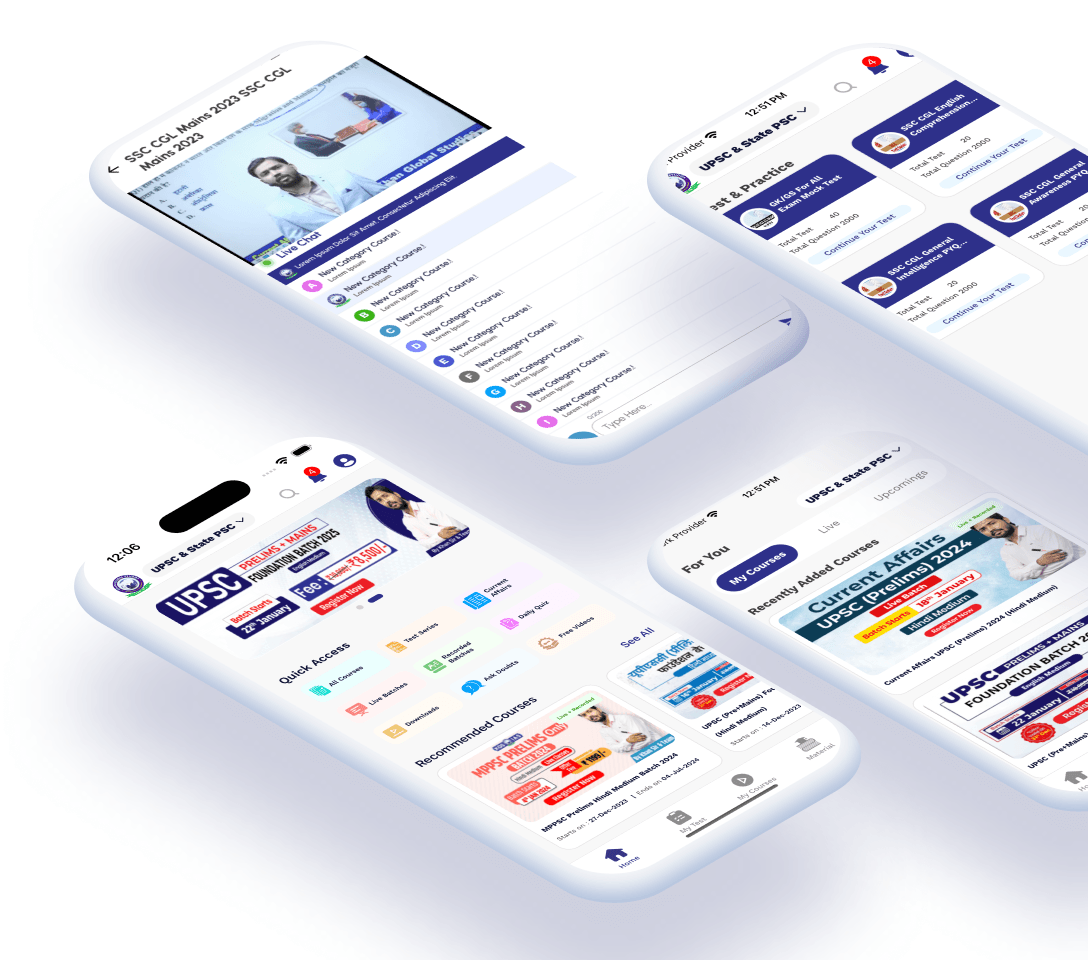
The most trusted learning platform on your phone
With our training programs, learning online can be a very exciting experience! Take the next step toward achieving your professional and personal objectives



NCERT Books
Resources
We love learning. Through our innovative solutions, we encourage ourselves, our teams, and our Students to grow. We welcome and look for diverse perspectives and opinions because they enhance our decisions. We strive to understand the big picture and how we contribute to the company’s objectives. We approach challenges with optimism and harness the power of teamwork to accomplish our goals. These aren’t just pretty words to post on the office wall. This is who we are. It’s how we work. And it’s how we approach every interaction with each other and our Students.
Come with an open mind, hungry to learn, and you’ll experience unmatched personal and professional growth, a world of different backgrounds and perspectives, and the freedom to be you—every day. We strive to build and sustain diverse teams and foster a culture of belonging. Creating an inclusive environment where every students feels welcome, appreciated, and heard gives us something to feel (really) good about.
Get Free academic Counseling & Course Details